In a first meeting, a client asks: "Should we build our site on WordPress, or should you custom-code it?" The short answer: if your initial budget is limited and you need a standard corporate website or online store, WordPress usually gets you started faster and for less; if speed, security and long-term scalability are your top priority, custom development is the better answer. Neither one always wins — the right choice depends on the goals, budget and growth horizon of that particular business.
The Onwebs web design team in Mashhad has worked with both WordPress and fully custom code, and it is exactly this experience on both sides that sets this comparison apart from a theoretical article.
If you're still not sure which type of website — corporate, e-commerce or institutional — fits your business, it's best to make that decision first, because WordPress and custom development both fall under that first choice.
What exactly is WordPress, and what is it not?
WordPress is a content management system (CMS): a ready-made core plus thousands of themes and plugins that let you launch a site without writing every line of code from scratch. For an online store, the WooCommerce plugin does the job; for a corporate site, a ready-made or semi-custom theme does.
What WordPress is not, though, is a magic tool for every kind of project. Every extra plugin is another layer of code that someone else wrote and that you don't fully control. The more plugins you add, the higher the risk of conflicts and security vulnerabilities. WordPress is excellent for "quickly launching something standard," not for building something no competitor in your market has.
What does custom development mean?
Custom development means the site is written from scratch around that business's exact needs — with no dependence on anyone else's theme or plugins. The Onwebs team built its own site, onwebs.ir, as well as khodroid.com, with Next.js; in other words, the page structure, load speed and SEO structured data were designed specifically for that purpose, not for websites in general.
The upfront cost of this route is higher, because nothing comes pre-built. In return, there is practically no predetermined ceiling on customization, and code you don't need never runs — which directly affects how fast the site really is.
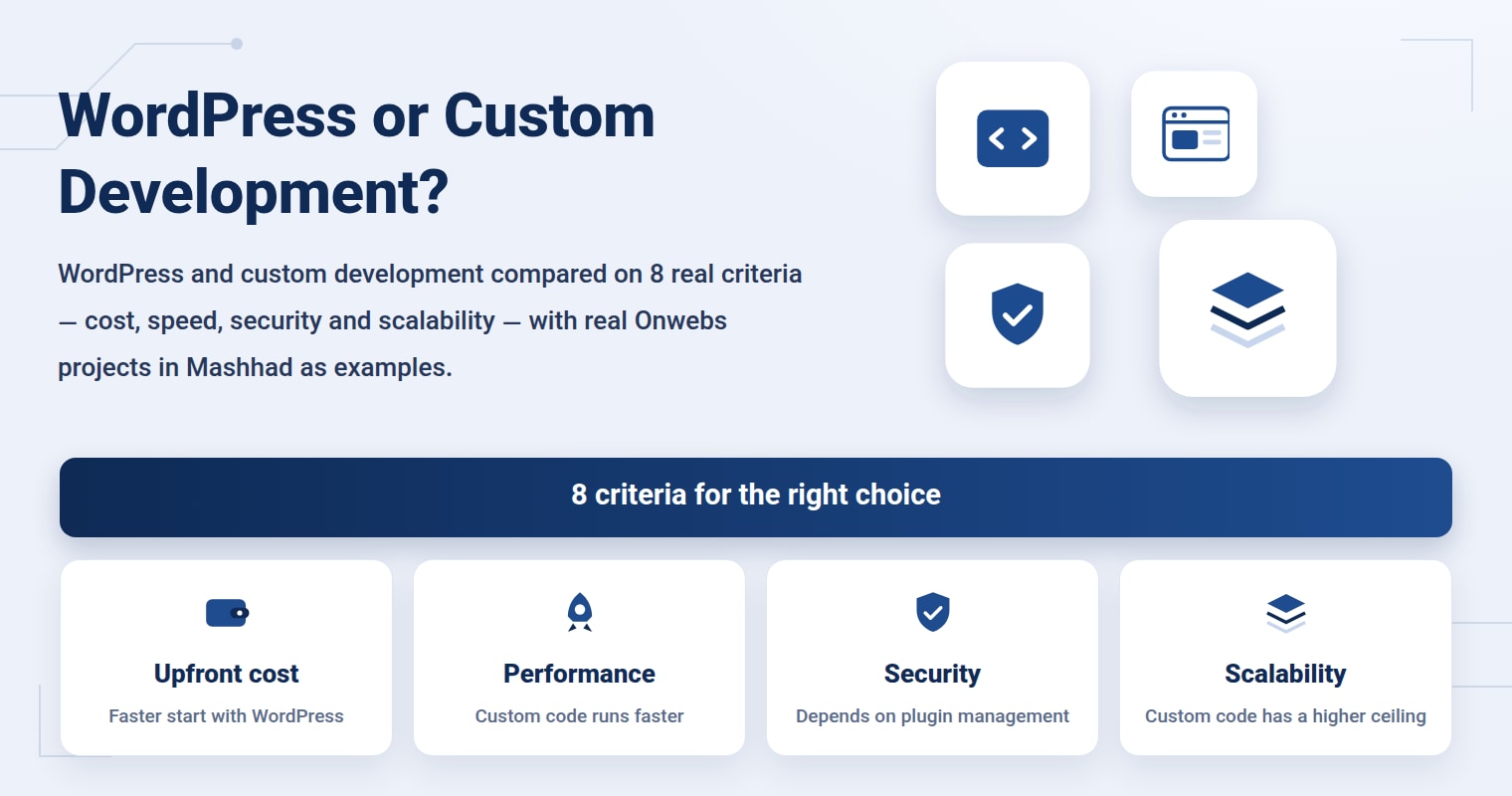
Comparing WordPress and custom development across 8 criteria
Before you make any decision, hold your own project up against this table:
| Criterion | WordPress | Custom development |
|---|---|---|
| Upfront cost | Usually lower | Usually higher |
| Time to launch | Faster, with ready-made themes and plugins | Slower, since every part is written from scratch |
| Site speed and performance | Depends on the number of plugins and the quality of the theme | Can be fine-tuned precisely for that project |
| Security | Higher risk with many poorly matched plugins | Smaller attack surface, full control over the code |
| Scalability and customization | As far as the plugins allow | Practically no predetermined ceiling |
| Long-term maintenance cost | Constant updates to the core and plugins | More stable, but requires a specialist technical team |
| Reliance on a technical team | Lower, for simple changes | Higher, even for minor changes |
| Technical SEO from the ground up | Possible, but depends on the quality of the SEO plugin | Built directly into the code architecture |
When is WordPress enough for your business?
When you need a standard corporate website or a store whose products aren't especially complex, and your initial budget is on the tighter side, WordPress is usually the most sensible choice. Talkoob — an online store for saffron, nuts and dried fruit that the Onwebs team built on WooCommerce — is a case where that was exactly the right call: a luxury shopping experience and product management, without having to write an entire store from scratch.
One of the decisions we made on the Fanavaran Sabz project was to go hybrid: the content management core stayed on WordPress, but the front end was fully custom-coded — because this corporate, industrial website needed simple content control, while its speed and look had to be handcrafted.
This example shows that WordPress and custom development aren't always two opposite ends of a spectrum; a hybrid setup is a real option too, especially when content management matters more to the client's in-house team than anything else.
When should you go with custom development?
When load speed, advanced technical SEO or a non-standard feature — such as an admin dashboard, integration with several other systems or a modular architecture — is an inseparable part of the project's goal, custom development is usually the only way to get there. That is exactly where onwebs.ir itself fits: built with Next.js, it had speed and technical SEO written into its code from day one, not bolted on as a patch after delivery.
Institutional projects usually call for this route as well. The booking and registration system for Khorasan Razavi's Institute for the Intellectual Development of Children and Young Adults (Kanoon) was custom-coded in PHP and React, because booking halls, camps and courses alongside an admin panel, all in one place, is not something an off-the-shelf plugin can handle.
Why is choosing the cheapest price a common mistake?
The most common mistake we see in Mashhad projects is comparing two proposals only by the figure at the bottom of the quote, rather than by the total cost over three years. A site built cheaply on WordPress with free plugins may look less expensive in the first few months, but if it later needs a complete redesign or a security fix, that initial saving disappears.
On the other hand, choosing custom development for a project where WordPress would have been entirely sufficient is the same mistake in reverse — money goes into something that isn't worth it for that particular business.
Decision guide: WordPress or custom development?
Before you make the final decision, go through this checklist with your web design team:
- Is your initial budget limited, and does the site need to launch quickly with standard features? Consider WordPress.
- Are load speed and technical SEO your business's top priority? Take custom development seriously.
- Do you need a non-standard feature or integration with several other systems? In that case, WordPress usually isn't enough.
- Does your in-house team need to change content often and extensively, without technical knowledge? That is exactly where WordPress shines.
- Have you considered your business's long-term growth horizon, not just today's cost?
If you're still unsure after this checklist, this is exactly the decision that a free consultation and estimate session with the Onwebs web design team will clear up; you can also see examples of both approaches in the Onwebs portfolio.
Frequently asked questions about WordPress and custom development
Is WordPress weaker for SEO than custom development?
With the right configuration and a suitable SEO plugin, WordPress can rank well, but its ceiling for technical optimization depends on the quality of the theme and the number of plugins. On WordPress projects such as Talkoob and Fanavaran Sabz, the Onwebs team in Mashhad implemented technical SEO separately on that same platform so this limitation would have less of an impact.
Is WordPress really cheaper to maintain in the long run?
Not always. Constant updates to the core and plugins, plus the risk of conflicts between them, push up the cost of maintaining WordPress over time. Before starting any project, the Onwebs team in Mashhad goes over this long-term maintenance cost with the client in a free consultation session, not just the cost on delivery day.
Can you start a project on WordPress and migrate to custom development later?
Yes, it's possible, but migrating usually costs more money and time than starting with custom development from the outset, because the data and the content structure have to be moved as well. The Onwebs team in Mashhad recommends making this decision in the very first meeting, based on the business's real growth horizon.
The bottom line: the right choice depends on your project, not on a blanket rule
My own experience is that this isn't a decision you make once and for all, the same way for every project. When I was designing our own site, onwebs.ir, I insisted on custom Next.js from the very start, because speed and technical SEO were an absolute priority for us — this is the site that has to serve as a showcase of our own work. On the Fanavaran Sabz project, though, I initially thought fully custom code was the best option; after one meeting with the client, I realized their in-house team wanted to keep changing the content of their product pages themselves, without depending on us. I changed the decision right there and we went hybrid — WordPress for content management, a custom front end for the look and the speed. To be honest, if it hadn't been for that meeting, we would probably have delivered a fully custom solution that would have forced the client's team to come to us for every small change — the very thing we wanted to prevent.
If you're still torn between WordPress and custom development, you can put this very question to the Onwebs team in Mashhad in a free consultation and estimate session and make your decision based on your project's real goal.